
Angular Support Very lightweight language support for angular definitions. Material Icon Theme The Material Icon Theme provides lots of icons based on Material Design for Visual Studio Code. It include seperate icon for example Angular-Services, Angular-Components, Angular-Directives. AngularJS in Visual Studio Search for 'angular' in the Manage NuGet Packages dialog box and install AngularJS Core. AngularJS in Visual Studio This will add AngularJS files into Scripts folder such as angular.js, angular.min.js, and angular-mocks.js, as shown below.
Angular 8.0 is out and so Visual Studio 2019 with .NET Core 3.0. With the recent preview release of .NET Core 3.0, the Angular SPA template for ASP.NET Core 3.0 has now been updated to use Angular 8. So you no longer have to install any third-party templates to create an Angular 8 based app. This post talks about how to create an Angular 8 App with Visual Studio 2019.

If you want to learn all of Angular, I want to personally recommend ng-book as the single-best resource out there. You can get a copy here. The book is updated to Angular 8.
In this post, we’ll use an ASP.NET Core 3.0 based Angular template project, which out of the box creates an Angular 8 app.
Before we create the application, first we need to install Visual Studio 2019 and .NET Core 3.0. Let’s first install .NET Core 3.0 SDK.
Installing .NET Core 3.0
To download .NET Core 3.0 preview, visit this link. Based on your platform, download the appropriate installer(if you have already installed, then please update to the latest version). Once the download is complete, run the installer to install .NET Core 3.0 on your system. The .NET Core 3.0 preview installation will not impact your existing .NET Core version installation.
Installing Visual Studio 2019 Preview
To install Visual Studio 2019 preview, download the installer from this location. Don’t worry. Visual Studio and Visual Studio “Preview” can be installed side-by-side on the same device. It will have no impact on your current stable VS installation.
Visual Studio 2019 offers a completely new project creation experience. You can read more about the new experience here. Once the installation is complete, let’s open the Visual Studio 2019 preview and create the ASP.NET Core 3.0 app. Select the ASP.NET Core Web Application template.
You will also need to install the latest version of Node.js, npm and Angular CLI. If you have already installed node then please update it to the latest version.
Now, open the Visual Studio 2019 preview and create the ASP.NET Core 3.0 app. Select the ASP.NET Core Web Application template. When you click Ok, you will get the following prompt. Select ASP.NET Core 3.0 (make sure ASP.NET Core 3.0 is selected) and choose the Angular template.
If you don’t see ASP.NET Core 3.0 in the dropdown, you can try these fixes provides in here and here. However, in my case, nothing worked. So to fix it, I uninstalled the VS 2019 and installed the latest version again. After successful installation, I was able to see ASP.NET Core 3.0 in the framework selection dropdown.
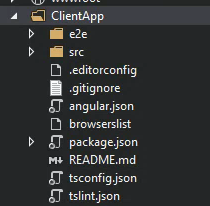
From the template selection dialog box, select Angular and hit OK. Visual Studio will take a few seconds to create the Angular application. Once the application is created, you can verify the angular version in the package.json file which is placed inside the ClientApp folder.
Now, just build the application and run it. You might get the following error (Such errors are expected as things are still in preview mode).
To fix this issue, open command prompt and navigate to the ClientApp folder. Now, execute ng build command once to build the application. After it is built successfully, come back to Visual Studio and run the app once again. This time you should see Angular 8 app running successfully in the browser.
Ideally, in development mode, there’s no need to run ng serve. It runs in the background automatically, so your client-side resources are dynamically built on demand and the page refreshes when you modify any file. The code is already in place in the Startup.cs file.
Since it’s still in preview, so this will be fixed when the final version comes out.
If you really want to master Angular 8, ng-book is the single-best resource out there. Get your copy here at 20% discount.
Thank you for reading. Keep visiting this blog and share this in your network. Please put your thoughts and feedback in the comments section.
Angular is a popular JavaScript library developed by Google for building web application user interfaces. The Visual Studio Code editor supports Angular IntelliSense and code navigation out of the box.
Visual Studio Angular Project
Welcome to Angular
We'll be using the Angular CLI for this tutorial. To install and use the command line interface as well as run the Angular application server, you'll need the Node.js JavaScript runtime and npm (the Node.js package manager) installed. npm is included with Node.js which you can install from Node.js downloads.
Tip: To test that you have Node.js and npm correctly installed on your machine, you can type node --version and npm --version.
To install the Angular CLI, in a terminal or command prompt type:
This may take a few minutes to install. You can now create a new Angular application by typing:
my-app is the name of the folder for your application. This may take a few minutes to create the Angular application in TypeScript and install its dependencies.
Let's quickly run our Angular application by navigating to the new folder and typing ng serve to start the web server and open the application in a browser:
You should see 'Welcome to app!!' on http://localhost:4200 in your browser. We'll leave the web server running while we look at the application with VS Code.
To open your Angular application in VS Code, open another terminal (or command prompt) and navigate to the my-app folder and type code .:
Syntax highlighting and bracket matching
Now expand the srcapp folder and select the app.component.ts file. You'll notice that VS Code has syntax highlighting for the various source code elements and, if you put the cursor on a parenthesis, the matching bracket is also selected.
IntelliSense
As you hover your mouse over text in the file, you'll see that VS Code gives you information about key items in your source code. Items such as variables, classes and Angular decorators are a few examples where you'll be presented with this information.
As you start typing in app.component.ts, you'll see smart suggestions and code snippets.
You can click the information button (i) to see a flyout with more documentation.
VS Code uses the TypeScript language service for code intelligence (IntelliSense) and it has a feature called Automatic Type Acquisition (ATA). ATA pulls down the npm Type Declaration files (*.d.ts) for the npm modules referenced in the package.json.
Go to Definition, Peek definition
Through the TypeScript language service, VS Code can also provide type definition information in the editor through Go to Definition (F12) or Peek Definition (⌥F12 (Windows Alt+F12, Linux Ctrl+Shift+F10)). Open the app.module.ts file and put the cursor over AppComponent in the bootstrap property declaration, right click and select Peek Definition. A Peek window will open showing the AppComponent definition from app.component.ts.
Press Escape to close the Peek window.
Hello World!
Let's update the sample application to 'Hello World'. Go back to the app.component.ts file and change the title string in AppComponent to 'Hello World'.
Once you save the app.component.ts file, the running instance of the server will update the web page and you'll see 'Welcome to Hello World!!'.
Tip: VS Code supports Auto Save, which by default saves your files after a delay. Check the Auto Save option in the File menu to turn on Auto Save or directly configure the files.autoSave user setting.
Debugging Angular
To debug the client side Angular code, we'll need to install the Debugger for Chrome extension.
Note: This tutorial assumes you have the Chrome browser installed. There are also debugger extensions for the Edge and Firefox browsers.
Open the Extensions view (⇧⌘X (Windows, Linux Ctrl+Shift+X)) and type 'chrome' in the search box. You'll see several extensions which reference Chrome.
Press the Install button for Debugger for Chrome.
Set a breakpoint
To set a breakpoint in app.component.ts, click on the gutter to the left of the line numbers. This will set a breakpoint which will be visible as a red circle.
Configure the Chrome debugger
We need to initially configure the debugger. To do so, go to the Run view (⇧⌘D (Windows, Linux Ctrl+Shift+D)) and click on the gear button to create a launch.json debugger configuration file. Choose Chrome from the Select Environment dropdown list. This will create a launch.json file in a new .vscode folder in your project which includes a configuration to launch the website.
We need to make one change for our example: change the port of the url from 8080 to 4200. Your launch.json should look like this:
Press F5 or the green arrow to launch the debugger and open a new browser instance. The source code where the breakpoint is set runs on startup before the debugger was attached so we won't hit the breakpoint until we refresh the web page. Refresh the page and you should hit your breakpoint.
You can step through your source code (F10), inspect variables such as AppComponent, and see the call stack of the client side Angular application.
The Debugger for Chrome extension README has lots of information on other configurations, working with sourcemaps, and troubleshooting. You can review it directly within VS Code from the Extensions view by clicking on the extension item and opening the Details view.
Popular Starter Kits
In this tutorial, we used the Angular CLI to create a simple Angular application. There are lots of great samples and starter kits available to help build your first Angular application.
Recipes
Visual Studio Extensions For Angular
The VS Code team has created recipes for more complex debugging scenarios. There you'll find the Chrome Debugging with Angular CLI recipe which also uses the Angular CLI and goes into detail on debugging the generated project's unit tests.
MEAN Starter
If you'd like to see a full MEAN (MongoDB, Express, Angular, Node.js) stack example, look at MEAN.JS. They have documentation and an application generator for a sample MEAN project. You'll need to install and start MongoDB, but you'll quickly have a MEAN application running. VS Code also has great MongoDB support through the Azure Databases extension.
React
React is another popular web framework. If you'd like to see an example of React working with VS Code, check out the Using React in VS Code tutorial. It will walk you through creating an React application and configuring the launch.json file for the Debugger for Chrome extension.
Visual Studio Angular Development

Angular Extensions
In addition to the functionality, VS Code provides out of the box, you can install VS Code extensions for greater functionality.
Click on an extension tile above to read the description and reviews on the Marketplace.
To find other Angular extensions, open the Extensions view (⇧⌘X (Windows, Linux Ctrl+Shift+X)) and type 'angular' to see a filtered list of Angular extensions.
The community has also created 'Extension Packs' which bundle useful extensions together (for example, a linter, debugger, and snippets) into a single download. To see available Angular extension packs, add the 'extension packs' category to your filter (angular @category:'extension packs').